3 Ways AI Recommendations Are Stealing Conversions from Your Brand
Discover the three hidden leaks where AI-powered search is quietly stealing your traffic, clicks, and conversions — and learn how to plug them before it's too late.

Marveriq Team
AI Visibility Experts

If you're still measuring performance by traditional SEO-driven traffic, prepare for a wake-up call. In 2026, brands are facing a new kind of threat — one that doesn't show up in Google Search Console, but quietly steals traffic, clicks, and conversions before they ever reach your site.
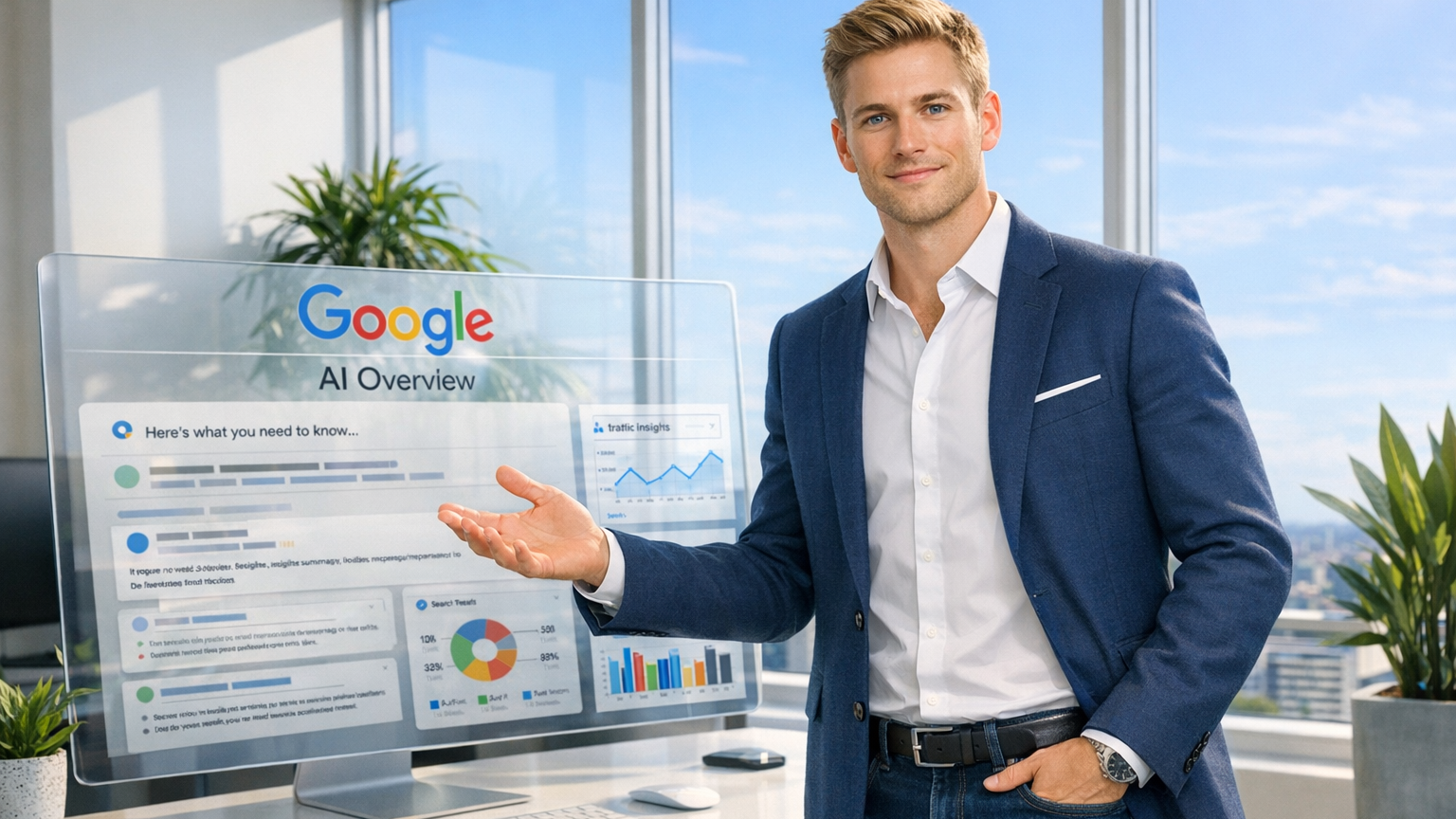
Meet the AI-driven "Answer Engines" — tools like ChatGPT, Google AI Overviews, Perplexity, and more — that are increasingly replacing traditional search results.
Recent industry data shows click-through rates from organic search dropping sharply when AI summaries appear — between 30–35% on average, with some categories seeing losses up to 80%. Search Engine Land
In plain English: people search, AI answers. They don't click.
But worse — if your brand isn't mentioned in those AI answers, you may as well not exist. Your traffic leaks before the click. And that means lost conversions, sales, and revenue.
This article reveals three hidden leaks where AI can sap value from your funnel — and shows how to plug them.
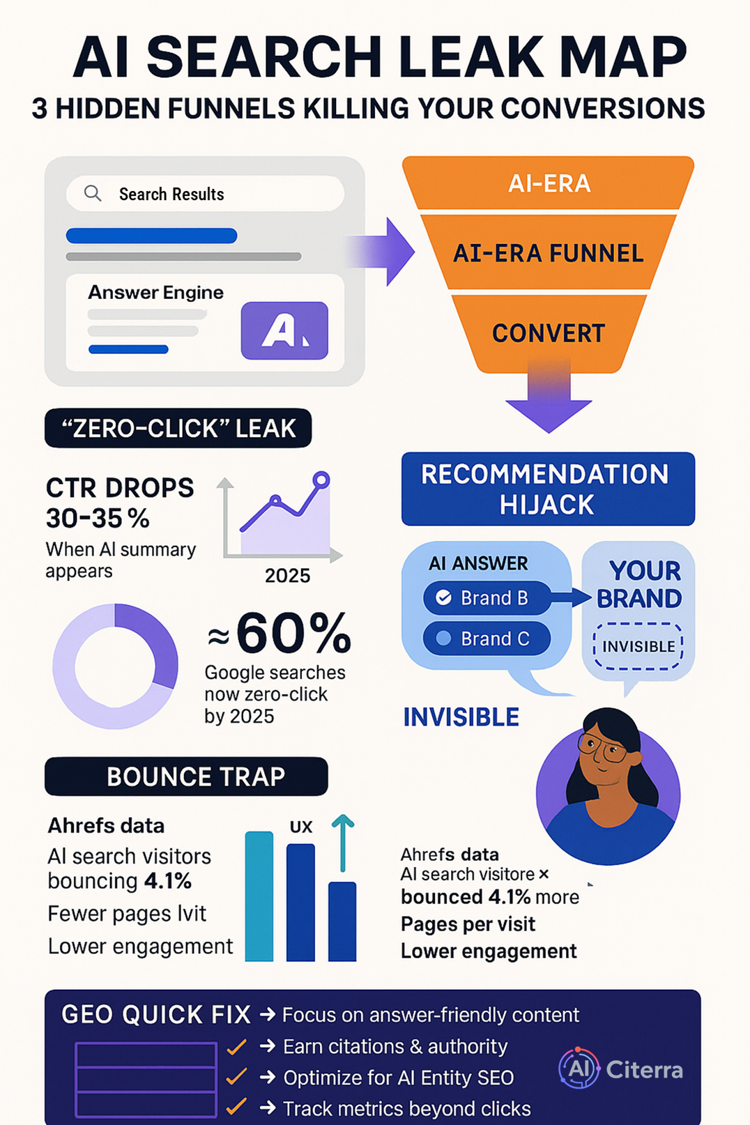
Leak #1: The "Zero-Click" Leak — When Answers Replace Clicks Entirely
What's happening
AI summaries and answer engines are creating a massive wave of zero-click searches. Instead of a list of links, users get a direct, conversational answer. No need to click.
- Studies show that when AI summaries appear, organic click-through rates drop by as much as 30–35%. Search Engine Land
- In a broader 2025 "organic traffic crisis" analysis, researchers found that ≈60% of Google searches now end without a click. Predictable Growth Marketing
- For eCommerce and retail brands — which often rely on organic traffic for product discovery — that means fewer eyeballs on product pages, fewer carts started, fewer conversions.
Why this leak is so insidious
- It happens silently — you may still rank #1, but those clicks vanish.
- It's systemic — as AI-search adoption grows, this affects more queries, more verticals.
- Legacy SEO doesn't protect you — traditional ranking and backlink strategies alone won't guarantee that AI answers cite you.
What brands can do to survive
| Action | Benefit |
|---|---|
| Audit AI visibility for key queries (product names, "best X", comparisons) | See where you appear or are missing — baseline for action |
| Publish answer-ready content (FAQs, concise product + feature summaries, comparison tables) | Increase chance AI will cite your brand when giving answers |
| Maintain clean structured data / schema / metadata | Makes your content machine-readable and trustworthy for AI algorithms |
Leak #2: The "Recommendation Hijack" — When AI Answers Recommend Competitors Instead of You
What's happening
AI doesn't just answer generic questions — it recommends. When users ask "What's the best mobile plan?", "Best running shoes under $100", or "Top business bank in UK," AI systems may suggest brands — and if your brand isn't optimized for AI, someone else gets the mention.
- Experts argue that traditional SEO alone no longer suffices. To be visible in AI-driven answers, brands must adopt what's now called Answer Engine Optimization (AEO) or Generative Engine Optimization (GEO). Forbes
- Recent analysis indicates the bias in AI search toward third-party authoritative sources over brand-owned content — meaning if you haven't earned external mentions or structured references, AI may never surface you. arXiv
Why this leak kills conversions
- You're invisible in high-intent queries.
- Even if you have great SEO, you won't show up in AI-driven decision moments.
- First-mover competitors who optimized for AI answers get disproportionate visibility — and capture demand you'll never see.
What brands can do to win back recommendation share
- Build external authority — get featured in industry publications, expert roundups, buyer guides, trusted 3rd-party reviews.
- Create content for AI citation — concise, fact-based, neutral-tone content (product specs, benefits, use-cases), easy for AI to parse.
- Monitor competitor AI presence — run sample queries, see who AI recommends. Track and benchmark.
- Implement GEO / AEO alongside SEO — dual-track optimization: ranking + visibility in answer engines.
Leak #3: The "Hidden Low-Value Traffic" Trap — When AI-Referred Visitors Don't Convert
What's happening
Some brands assume that even if AI brings fewer clicks, those clicks convert higher — but data suggests it's not that simple.
A 2025 study from Ahrefs found that traffic from AI-search referrals ― across ChatGPT, Perplexity and similar platforms — bounced 4.1% more often, viewed fewer pages per session, and had lower on-site engagement than traditional search referrals. Search Engine Land
In other words: AI referrals can be low-quality if the site isn't optimized for AI-driven intent and clarity.
Why this leak can waste effort
- High bounce + low engagement → poor signal to algorithms and analytics misleading you on value.
- If content is not structured for clarity or relevance, AI-referred visitors may not find what they expect, hurting conversion or retention.
- Over-reliance on "AI referral = high intent" is dangerous, especially if site experience, UX and content alignment are poor.
What brands should do to avoid the trap
- Optimize site architecture and UX — make sure AI-referred visitors land on clear, immediately useful pages.
- Use answer-ready content with context and navigational cues — so AI-referred users find value quickly instead of bouncing.
- Track new KPIs beyond clicks — bounce rate, pages per session, conversion rate of AI-referred traffic. Compare vs traditional search.
- Combine AI-visibility strategy with strong on-site experience — visibility alone isn't enough; delivery matters.
Conclusion: Fix the Leaks — Or Lose the Funnel
The rise of AI-powered answer engines isn't a fad. It's a structural shift in how people discover, research, and choose products or services online. That means the funnel you built for Google — ranking → click → conversion — no longer works reliably.
If you don't adapt, your funnel will leak: silently and steadily.
But the shift also brings opportunity.
Brands that adopt GEO / AEO — citation-ready content, structured data, external authority, AI-optimized UX — can:
- Reclaim visibility in answer engines
- Capture high-intent demand before competitors
- Protect and optimize conversion funnels for AI-referred traffic
In short: the future of digital discovery isn't just about ranking — it's about being recommended.
Use this guide to identify leaks, audit your visibility, and rebuild a funnel designed for 2026 and beyond.
Stay visible. Stay relevant.
— The Marveriq team
Ready to See Who's Winning AI Visibility?
Take our Free 5-minute GEO Maturity Assessment to discover how you stack up against competitors in AI answers — and get a personalized action plan.
Ready to Dominate AI Search?
Start tracking your brand's AI visibility today with Marveriq's comprehensive platform.
Start Free Trial